Thursday, August 28, 2008

Two Faced

"Cartagena tiene dos caras" (Cartagena has two faces), was what Guillermo, the guard at the boxing gym told me the other day. Without any need for elaboration, I already knew what he was referring to. The taxi ride from the bus terminal to my hostal was like driving through the gritty streets of an LA ghetto to the paved marble of Beverly Hills, only it was a 10 min drive from each other.

At first we drove by streets filled with trash piled randomly along the roadside, rusted metal grills encrusted over broken glass windows and peeling paint jobs over molded wood that pleaded for renovation, I thought, "so this is Cartagena." But as we passed by the very blatant divider of the historic city center, my eyes were soon greeted by high rises and upscale speciality stores; a metamorphasis into a man-made paradise available for sale or rent to the casual traveler.

The hostal where I first stayed at and now work is located in the richest area of Cartagena, but ironically is my cheapest option as my employment earns the room and board. The boxing gym, unsurprisingly, resides in one of the more impoverished areas and the boxers come from even humbler origins as their neighborhoods don't even appear on the map plastered on our hostal wall. I enter and return to two different places everyday, virtually two different worlds. Each passing day making it harder to comprehend how such inequalities can be in such close vicinity and seemingly overlooked.

When visitors ask me what there is in Cartagena, I try to casually mention in between the Volcano tour and the Chiva party bus that in reality Cartagena is extremely impoverished and retains an underlying system of racial segregation, but most guests just reply with nervous smile and ask where the nearest beach is. Hell, I can't blame them. Most, after all, are on vacation. Perhaps they lead very socially conscious lives and I still haven't learned to lighten up. I've just lost too much faith in humanity to believe that.

(Outside of my hostal.)

(Outside the home of a fighter.)

("Barrio Bocagrande")

("Barrio Olaya")

These two neighborhoods are fifteen minutes away from each other.

Wednesday, August 6, 2008

Something is...missing.

I’ve always wanted to learn how to file taxes, I just never thought I’d learn it in Venezuela.

As I was sitting at my couchsurfing host’s dining room table, working on some old credit card statements, a stout and lofty figure crept into the house. By the “who the hell are you and what are you doing in my house” look on his face, I knew it was the owner Scot had warned would be pissed if he found me there.

And sure enough, he was, booting us both out and now for the past few weeks I’ve been helping Scot file nearly four years worth of taxes, working anywhere between ten and eighteen hours a day in a kind of hotel that charges by the four hours. I would be lying if I said I always wanted to learn fire-modeling, but here I am nonetheless, diagramming churches and simulating fires to calculate the time people would have to evacuate the premise.

Beyond the short lived revival of my geometry and calculus skills, this unexpected lengthy stay in Venezuela has been a twisted labyrinth of emotions, but most notably, guilt. I don’t think I’ve ever personally caused another person this many problems. I feel like everything I try to help with makes the next thing worse. It would have been better if I just never showed up at all.

I haven’t written anything for the past few weeks, frankly because I’ve felt like I’ve lost my ability to write anything readable. The words no longer effortlessly find each other, translating thoughts into sentences has become painfully difficult to the point where I’ve just lost my will to keep writing. This place has taken something from me and I need to move on to recover it. Maybe I’ll find my integrity there too.

Friday, August 1, 2008

Public Service Announcement

Turn off the idiot box. Turn off the idiot box. Turn off the idiot box. Turn off the idiot box. Turn off the idiot box. Turn off the idiot box. Turn off the idiot box. Turn off the idiot box. Turn.....

...off

Tuesday, July 22, 2008

The Path of Most Resistance

"People have (with the help of conventions) oriented all their solutions toward the easy and toward the easiest side of easy; but it is clear that we must hold to what is difficult; everything alive holds to it, everything in Nature grows and defends itself in its own way and is characteristically and spontaneously itself, seeks at all costs to be so and against all opposition. We know little, but that we must hold to what is difficult is a certainty that will not forsake us; it is good to be solitary, for solitude is difficult; that something is difficult must be a reason the more for us to do it."

- Rainer Maria Rilke, 1904

Wednesday, July 9, 2008

Epilogue en Venezuela


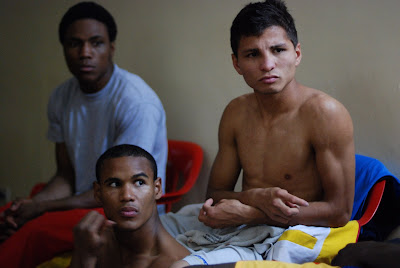
Alexis lost his first fights at both tournaments. I'm not exactly sure what he plans on doing afterwards, but I believe it will be continuing in his daily routine. Right now he only boxes part time, the other half he spends working at a factory that makes dish drying racks. He was the same fighter who told me the danger in his strata-2* neighborhood was "normal". I hope he can find more peaceful normalcy in his future.


Jeyson advanced to the semi-finals of the first tournament but eventually lost to a fellow Colombian who is headed to the upcoming summer Olympics in Beijing. In my opinion he was robbed of the decision at the second tourney. No shame in his performances and he doesn't seem to think so either. When I asked him if he saw a future in boxing, he seemed doubtful, saying he'd rather settle with something that allowed him to travel. China was where he would go first.


Pitalua, the "hothead", came up short in both tournaments, but accepted his silver medal with graceful sportsmanship. Of all the fighters, he had been apart from his family the longest, 2 years and counting, simply saying things between him and his mother haven't worked out. But I remember him telling me the reason he began boxing was for his mother, to give her a better life and for her to be proud of him. If and when they do reunite, I'm sure he will have accomplished both.


Fiader Hernandez placed a respectful third at both tournaments, having the difficult task of fighting his teammate at the former. These were to be his last amateur tournaments as he plans to turn pro later this month. This career change will force him to move from the strata-3 neighborhood of the athletic apartments to a strata-1, as the league does not support pro-fighters. Before we parted, I begrudingly exchanged my hat for one of his shirts, thinking it would be a small token of well-wishing for his uncertain future.


Cesár bettered his third place performance by triumphantly winning the gold at the following tournament. The look on his face reminded me of when he was reminiscing about art school. I couldn't be happier for him. I hope now the trip was worth it for him and his soon-to-be family. Before I left, he gave me one of his training jersyes and said "quiero que tengas eso, para un recuerdo de Bogotá, y ahora tú puedes decir que habia un tiempo que conocías Cesár Villanaer" (I want you to have this, for a souvenir of Bogotá and now you can say there was a time that you knew Cesár Villanaer).


This has been the longest and probably in the closest proximity that I've stayed with a boxing team. If I learned anything, it was the unselfish act of sharing. It was difficult to part with the hat that I really liked and traveled with for so long, but I remembered the generosity of Cesár and thought gestures like that needed to be passed on. To the final moments the team helped carry me as they insisted on me riding their bus as close as possible to my next destination. It wasn't until I descended those steps did I realized that I may never see or know any of them ever again. But I suppose I'm slowly learning how to accept the inevitable, and perhaps Cesàr was right. At least I can always say there was a time where we did know each other.


*Colombia is literally stratified. Cities are divided into sections called "stratas", ranking from 1 to 6. The number indicates accordingly the area's local income, availability of public services and so on. Strata-1 and strata-2 neighborhoods have the least amount of resources and unsurprisingly, the highest incidents of violent crime.

Saturday, July 5, 2008

Civil Democracy


As I was jotting my thoughts down the other night, one of the boxers, Jeyson, asked me if I had another pen. I didn't but I told him he could borrow mine, thinking whatever it was, it would only take a few minutes. With nothing to do, I thought it would be a good idea to shower since we all had to share one between the 11 of us. As I stepped out half-naked in my underwear, the fighters were grouped around in a large circle, much like how one used to do in grade school. After a few awkward seconds and a couple of odd glances, I broke the silence by asking what they were doing. They told me they were discussing the problems with Bogotà's boxing league and were collaboratively composing a letter of their sentiments to the coordinators. They had needed my pen to list the changes they all had agreed upon.

The setting reminded me of my sections in college. Topics were brought up orderly, hands were being raised, all voices and input being heard. Never once did anyone speak out of turn, never once over one another. By the time I finished showering the meeting was over. I went to Cesàr's room and asked what kind of things they had asked for. He said for better accomodations on trips like this one, better equipment (as most of them had to share shoes) but most importantly the opportunity to study.

In Cesàr's case that meant art school, which he had to abandon for work when his father left the family. By the way he talked about art and the smile in his eyes, I would guess he'd much rather do that than work 10 hours a day and endure a 3 hr training session afterwards. Soon after, Jeyson joined us to elaborate on the situation, but before saying anything related to the meeting, he looked at me with a kind face and asked ¿Ya banaste? (Have you already showered?)

Throughout my stay with the team I've been asked a variety of "ya's". ¿Ya dormiste? ¿Ya comiste? (Have you slept? Have you eaten?) If I ever answered "no" to any of these questions, they would quickly scramble to find some recourse for me to receive the same as they had. One boxer, Fiader, used to even invite me to eat lunch back in Bogotà even though I had my own accommodations and it really could have got him in considerable trouble. Apparently during the meeting he brought up the issue of me having to pay for the second leg of my journey, which, to my discomfort, outraged many of them. They told me not to worry, that they were going to handle it for me, but I ended up paying anyways. It came out to about $70 USD for a week's stay, with the trainer only charging me for 5, and in Venezuelan Bolivares rather than Colombian Pesos. I didn't want to cause any of them problems back in Bogotà, and after Jeyson needed to purchase medication for a rumptured eardrum he received in his last bout, I figured it was the least I could do after all the kindness I had received.

Being with these fighters constantly reminds me of the incomprehensible imbalance in this world. Had Cesàr been in the States, perhaps the same circumstances would have passed, but it was his passion that made the difference. His passion represented how many people I've met along this trip that would kill to just have the opportunity to study. And to think in the States, people complain about their course load, stress over what to major in, and student athletes believe they are "forced" to study when others have to hold union meetings to become one. I almost feel a bit shameful when I tell people about my scholarship, embarrassed that there exists a world where one can virtually be paid to travel and I am living in it (although perhaps the catch-22 here is that I would have never realized it if I hadn't been able to travel).

But when I told Jeyson about my journey, he was just, happy for me. It really said something to me, the absence of bitterness that is. Despite my situation being somewhat reflective of the unfairness in the world, for them to just be happy that someone could experience such an opportunity, was well, big of them.